
Technical Architecture & Execution
A real-world delivery record with transparent architecture decisions.
Project Snapshot
Business Problem
Confidential engagement · Rental Companies · AI Agents
Production Outcome
Approved public project record.
Technologies & Integrations
04How Equipment Hire Companies Are Finding Projects Before Their Competitors Even Know They Exists
The problem: by the time you hear about a project, it's already too late
A $40 million infrastructure upgrade doesn't appear out of nowhere. Months before the first piece of equipment arrives on site, it exists as a government tender notice, an ASX contract-award announcement, a mining approval filing, or a council infrastructure proposal — scattered across dozens of portals that nobody in your sales team has time to check every day.
By the time a project shows up on your radar through word of mouth or a cold call from the winning contractor, the equipment-hire company that found it three weeks earlier is already the one with a quote on the table.
This is the actual problem Anaxa was built to solve — not "more leads," but earlier leads, sourced from the same public records that already announce every project, before your competitors get there first.
It's also a bigger opportunity than it looks. Australia's machinery and scaffolding rental industry alone is a $12.2 billion market spread across more than 10,400 businesses, growing at roughly 3.3% a year — a large, fragmented field where being first to a project consistently matters more than being the biggest name in it (IBISWorld, 2026).
What is Anaxa?
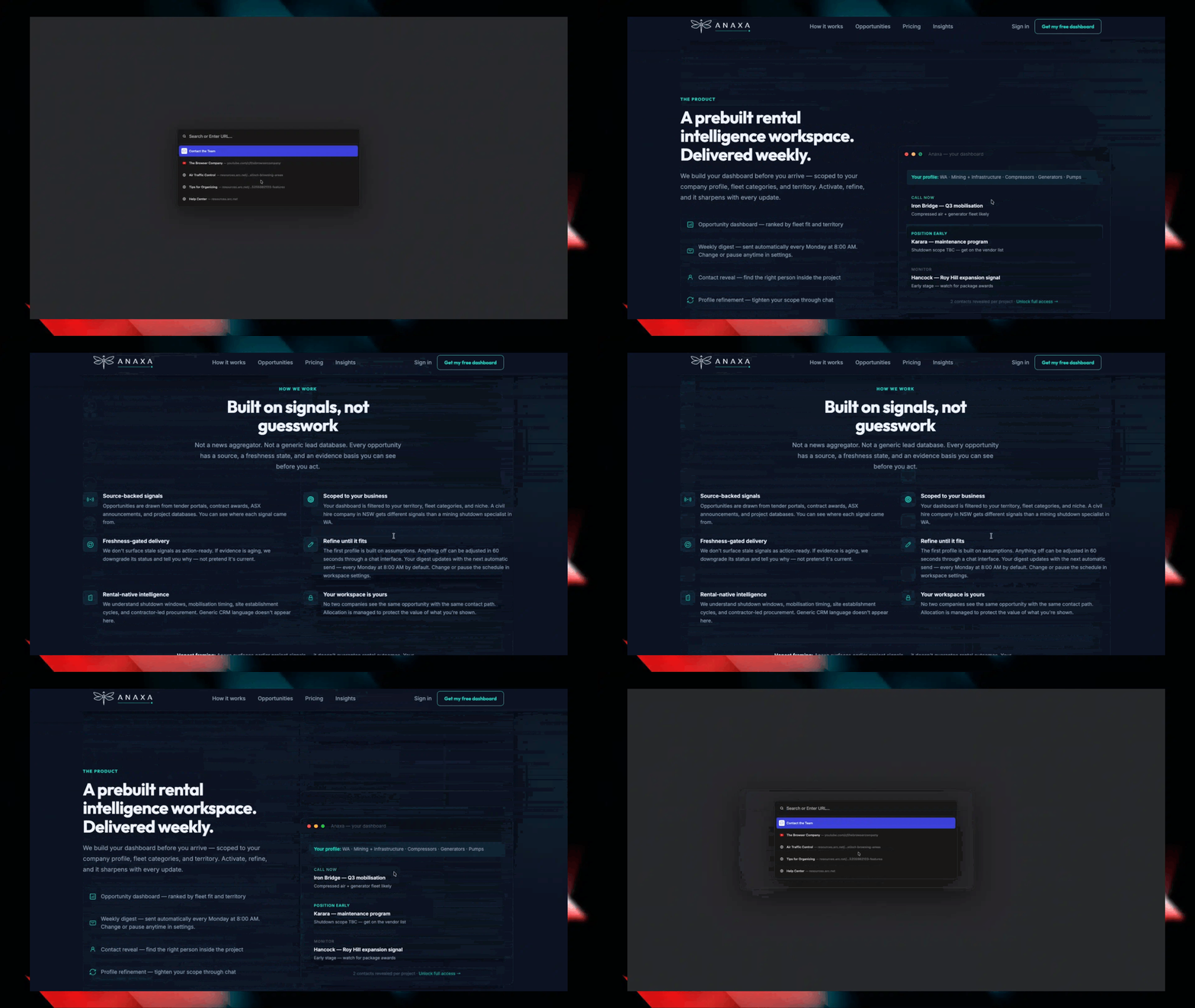
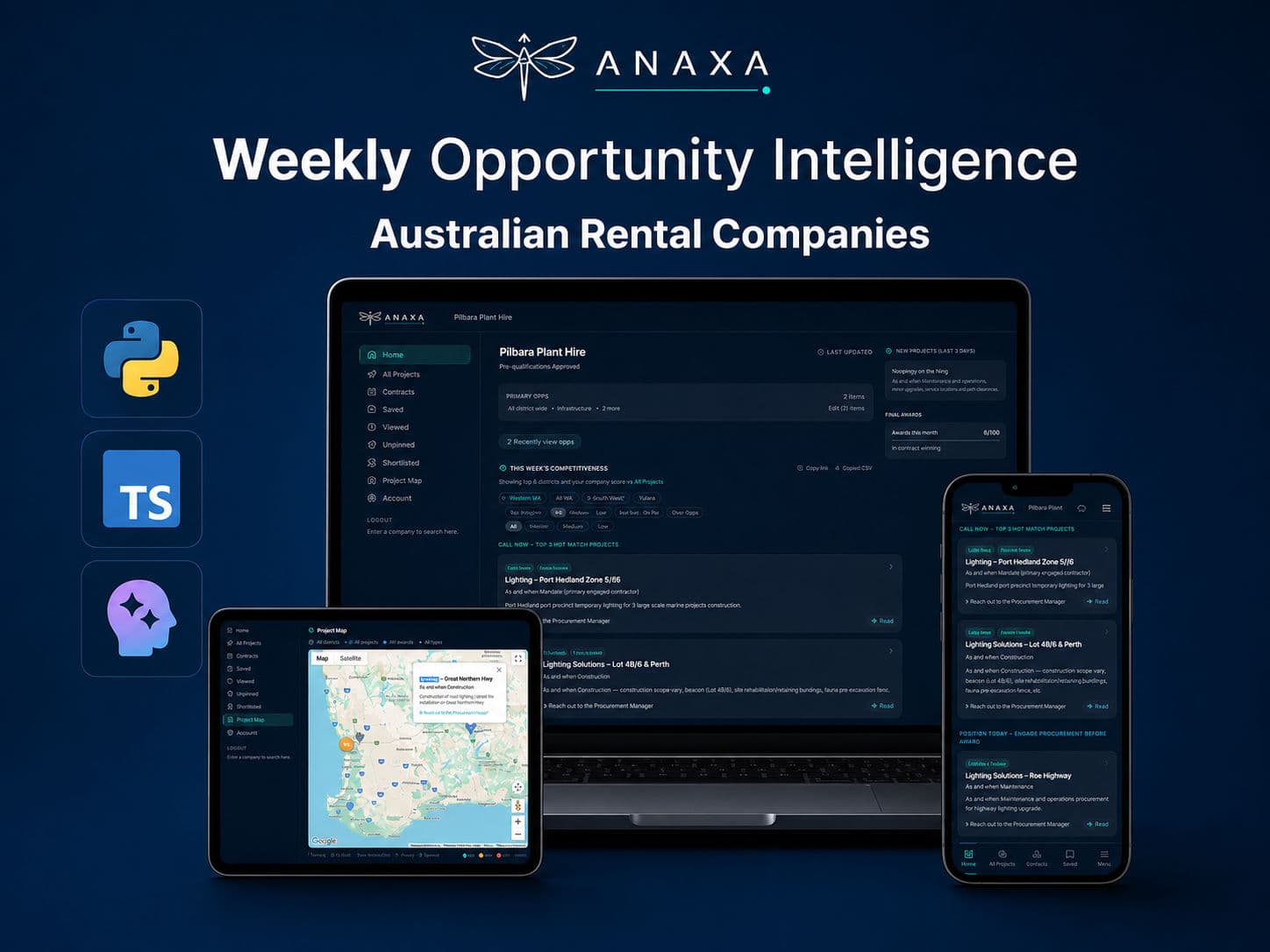
Anaxa is a project-intelligence platform for equipment and plant hire companies. It continuously scans public data sources — federal and state tender registers like AusTender and the ICN Gateway, state and territory infrastructure pipelines, ASX contract-award announcements, mining project approvals, port authority capital works, and industry trade press — and turns that raw information into a filtered, ranked list of upcoming projects that are actually relevant to what a specific hire company rents out.
Under the hood, that means three things running every day, automatically:
- Discovery. Dozens of scrapers pull structured and unstructured project data from sources like AusTender, the ICN Gateway, state tender portals, ASX announcements, and mining/infrastructure databases — the same primary sources project managers and BD teams already know about, just checked continuously instead of manually.
- Allocation. Every discovered project gets scored and matched against a workspace's specific profile — the regions it operates in, the equipment categories it hires out, the project sectors it's actually positioned to serve — so a scaffolding company doesn't get flooded with dewatering-pump opportunities and vice versa.
- Contact discovery. Once a project is allocated as relevant, Anaxa finds the people actually worth contacting at the awarded contractor or project owner, so the output isn't just "here's a project" but "here's who to call."
The result is a workspace that shows a hire company's sales team a live, personalized feed of upcoming work — not a generic news digest, and not a list they have to go build themselves from six different government websites every morning.
Why "just check Google" doesn't work like it used to

There's a second, quieter shift happening alongside all this: the way B2B buyers actually research vendors has changed faster than most sales teams have caught up with. As of a March 2026 multi-source analysis, 73% of B2B buyers now use AI tools like ChatGPT and Perplexity somewhere in their research process, and 51% of B2B software buyers say they now start that research with an AI chatbot more often than with Google — up from just 29% less than a year earlier (G2 Research, 2026).
That matters for two reasons. First, it's part of why the "just Google it" approach to finding projects is breaking down generally — the same AI-driven shift in behavior that's changing how buyers evaluate software is changing how information gets surfaced everywhere, including tender data. Second, and more concretely: Google's own AI Overviews are now suppressing organic click-through so sharply that finding anything by manually searching and clicking through results is measurably harder than it was a year ago. Ahrefs' most recent analysis, run in December 2025 across 300,000 keywords, found AI Overviews cutting click-through rates to the top organic result by 58% — nearly double the 34.5% drop the same team measured just eight months earlier (Ahrefs, 2026; eMarketer, 2026). Manual search isn't just slow for finding projects — it's actively getting less reliable as a discovery method, for the same structural reason it's getting less reliable for everything else.
What makes Anaxa different from checking tender sites yourself, or a general lead-gen tool?
The honest answer is that none of the individual data sources Anaxa pulls from are secret. Tender registers are public. ASX announcements are public. Mining approvals are public. Anyone could, in theory, check all of them by hand every day.
That's exactly the point — and exactly why it doesn't happen. Here's what actually separates a platform built for this from doing it manually or relying on a generic sales-intelligence tool:
| Checking sources manually | Generic lead-gen / sales intelligence tool | Anaxa | |
|---|---|---|---|
| Coverage | Whatever one person has time to check | Broad, industry-agnostic company data | Purpose-built scrapers across government, ASX, and industry sources specific to construction/infrastructure/mining project flow |
| Timing | Found whenever someone happens to look | Reactive — surfaces companies, not upcoming projects | Surfaces a project close to when it's publicly announced, not after it's already been awarded and mobilised |
| Relevance filtering | None — every source is undifferentiated noise | Matches by company firmographics, not project fit | Matched to a workspace's actual equipment categories, regions, and sectors |
| Claim verification | Whatever the source says, taken at face value | Rarely re-verified against primary sources | Contractor and award claims are checked for ambiguity (joint ventures, non-contractor roles, wrong project stage) before they reach a sales rep |
| Next step | Find a project, then separately go find a contact | Contact data, but disconnected from which project matters right now | Project and the right contact for it, delivered together |
The verification piece is worth being specific about, because it's the part most tools skip. Automated scraping is easy; automated scraping that doesn't quietly hand your sales team a wrong claim is the harder problem. Project announcements are frequently ambiguous in ways that matter — a joint-venture partner gets named alongside the actual contractor, an architect or engineer gets listed the same way a construction contractor would be, or a project that's still years from breaking ground gets reported with the same certainty as one that's mobilising next month. Anaxa's pipeline checks for exactly these patterns before a claim is presented as fact, rather than passing along whatever the source implied.
Who is Anaxa actually for?
Anaxa is built specifically for equipment and plant hire companies — the businesses that need to know a project exists before it needs a crane, a generator, or a dewatering pump on site, not after. That includes rental companies operating in mining, civil construction, infrastructure, and industrial sectors across Australia, where the gap between "project announced" and "equipment needed" is exactly the window where being early actually wins the work.
FAQ
How is this different from a Google Alert for tender keywords? A Google Alert surfaces mentions of a keyword; it doesn't score whether a project fits your specific equipment categories, doesn't verify who's actually named as the contractor versus a JV partner, and doesn't tell you who to contact. Anaxa does the filtering and verification work a Google Alert leaves entirely to you — which matters more now that AI Overviews have made manual search itself less reliable as a discovery method.
Does Anaxa only cover government tenders? No — the pipeline also covers ASX contract-award announcements, mining project approvals, port authority capital works, and industry trade press, since a meaningful share of upcoming project work is announced outside formal tender registers entirely.
How current is the data? Sources are checked on a daily automated cycle, so a project surfaces close to when it's publicly announced rather than whenever someone next happens to check the source manually.
Sources
- Construction Machinery and Operator Hire in Australia Market Size Statistics — IBISWorld, 2026
- AusTender Homepage — Australian Government
- Gateway by ICN — Industry Capability Network
- New G2 Research: Half of B2B Software Buyers Now Start Their Research With AI Chatbots — G2, 2026
- AI Overviews Reduce Clicks by 34.5% — Ahrefs, 2025 (earlier figure)
- Google AI Overviews decrease CTRs by 34.5%, per new study — eMarketer, 2026 (reporting on the December 2025 update to 58%)